

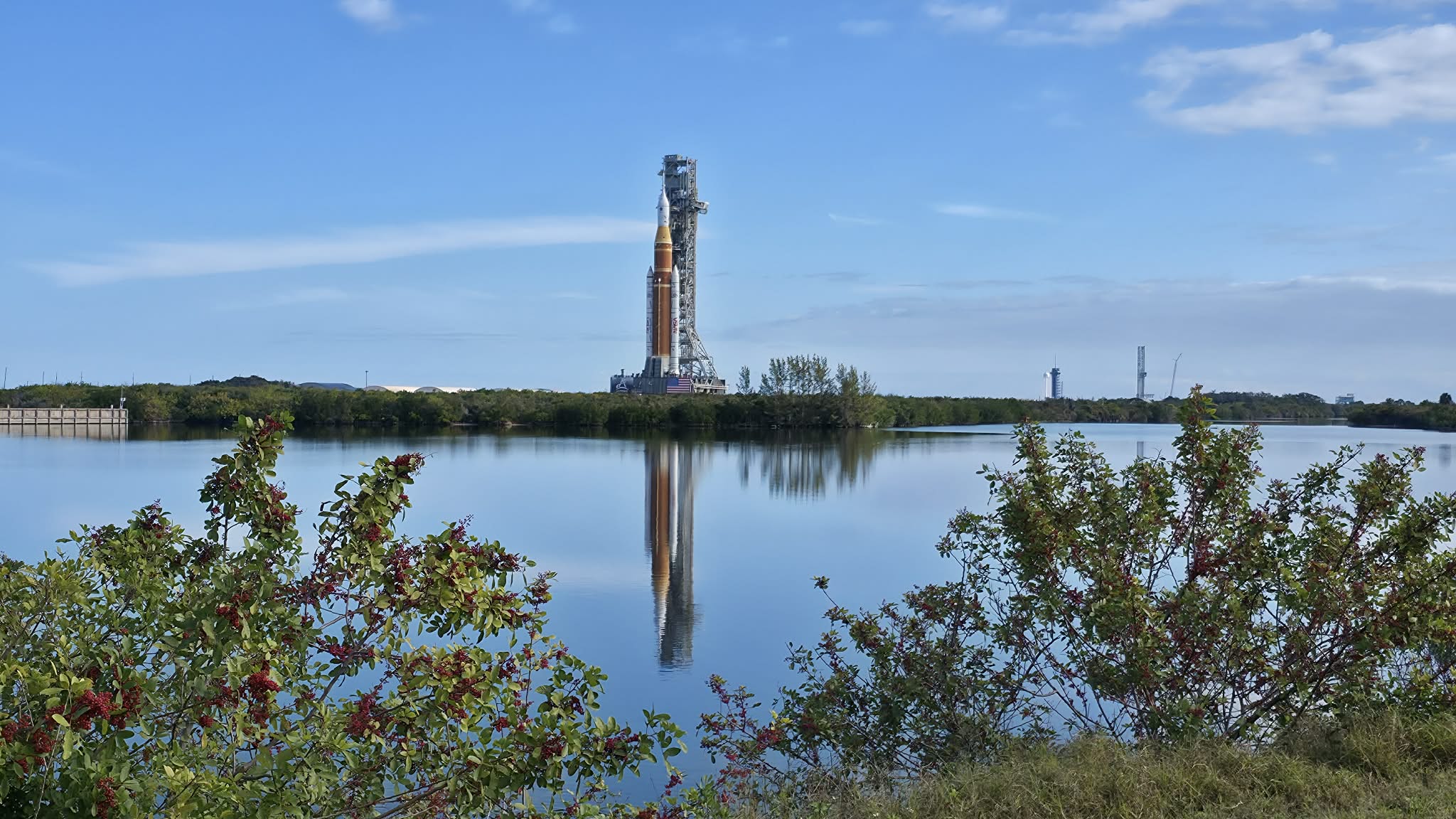
CAPE CANAVERAL, Fla. — NASA has taken a major step toward its first crewed mission to the Moon in more than half a century, rolling the towering Artemis II Space Launch System (SLS) rocket and Orion spacecraft to Launch Pad 39B at Kennedy Space Center.
The rollout marks the transition from assembly to final launch preparations for Artemis II, the first mission in NASA’s Artemis program to carry astronauts beyond low-Earth orbit since Apollo 17 in 1972.
Standing 322 feet tall, the SLS rocket was transported from the Vehicle Assembly Building atop NASA’s massive crawler-transporter during an overnight journey covering roughly four miles. Once secured at the pad, teams will begin final system checkouts, pad integration, and countdown rehearsals.
NASA is targeting early 2026 for the Artemis II launch, with its earliest launch opportunities beginning February 6, 2026. Additional launch dates are available February 7, 8, 10, and 11, depending on weather conditions and final readiness milestones. Backup launch windows extend into March and April 2026 if needed.
A specific launch date will be confirmed following completion of the wet dress rehearsal—a full countdown test in which the rocket is fueled with more than 700,000 gallons of cryogenic propellant—and a formal flight readiness review.
Artemis II will carry four astronauts—NASA’s Reid Wiseman, Victor Glover, and Christina Koch, along with Canadian Space Agency astronaut Jeremy Hansen—on a roughly 10-day mission that will loop around the Moon and return to Earth. The mission will follow a free-return trajectory, allowing the spacecraft to naturally swing back home using lunar gravity.
Although Artemis II will not attempt a lunar landing, it will serve as a critical test flight for life-support systems, deep-space navigation, communications, and crew operations in the harsh environment beyond Earth orbit.
Success of Artemis II will clear the way for Artemis III, which aims to land astronauts near the Moon’s south pole later in the decade. The Artemis program is central to NASA’s long-term strategy to establish a sustained human presence on the Moon and use lunar missions as a stepping stone for future crewed exploration of Mars.
As final tests get underway at Launch Pad 39B, Artemis II now stands as the most imminent human return to lunar space in over 50 years—bringing NASA closer to a new era of deep-space exploration.